

What is the role of lubricants in the cold drawing process of steel wire?
What is the role of lubricants in the cold drawing process of steel wire?
In the steel wire production industry, the cold drawing process stands as a fundamental and crucial method for producing high - quality steel wires with precise dimensions and enhanced mechanical properties. As a reputable Cold Drawn Steel Wire [Let's assume you are a real industry insider named John Smith] supplier, I have witnessed firsthand the significance of lubricants in this intricate process.
The cold drawing process involves pulling a steel wire through a die to reduce its cross - sectional area and achieve the desired diameter. This seemingly simple operation, however, involves a complex interplay of mechanical forces, heat generation, and surface interactions. Without the use of appropriate lubricants, the cold drawing process would be fraught with challenges, and the quality of the final product would be severely compromised.
One of the primary roles of lubricants in the cold drawing process is to reduce friction. When the steel wire passes through the die, the frictional forces between the wire surface and the die wall can be substantial. High friction can lead to several problems. Firstly, it increases the drawing force required to pull the wire through the die. This not only places excessive stress on the drawing equipment but also raises energy consumption. For example, in a continuous cold drawing line, if the friction is not properly controlled, the motors driving the drawing process may have to work at a much higher capacity, leading to increased electricity costs and potential premature wear of the machinery.

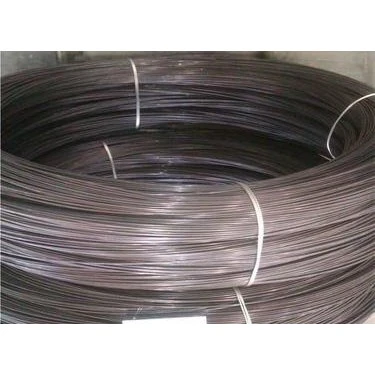
Secondly, excessive friction can cause significant surface damage to the steel wire. The intense rubbing can generate scratches, abrasions, and surface cracks on the wire. These surface defects not only affect the aesthetic appearance of the wire but also weaken its mechanical properties. A wire with surface cracks is more prone to fatigue failure under cyclic loading, reducing its reliability in applications such as Phosphate Coating Steel Wire, where high - strength and durability are essential.
Lubricants act as a barrier between the wire and the die, reducing the direct contact and thus minimizing friction. They form a thin film on the wire surface, which separates the two surfaces in relative motion. This lubricating film can either be a boundary lubricant, which adheres to the metal surfaces at low speeds and high pressures, or a hydrodynamic lubricant, which forms a continuous fluid layer under high - speed conditions. The choice of lubricant depends on various factors such as the drawing speed, reduction ratio, and the type of steel wire being processed.
In addition to reducing friction, lubricants also play a vital role in heat dissipation. The cold drawing process is accompanied by the generation of a significant amount of heat due to the plastic deformation of the steel wire and the frictional forces. If this heat is not dissipated effectively, it can cause several problems. High temperatures can lead to microstructural changes in the steel wire, such as grain growth and phase transformations, which can degrade its mechanical properties. For instance, in the production of Oil Tempered Steel Wire, precise control of the microstructure is crucial for achieving the desired strength and toughness. Excessive heat can also cause thermal expansion of the wire and the die, leading to dimensional inaccuracies in the final product.
Lubricants help in dissipating heat by carrying it away from the contact area between the wire and the die. They act as a coolant, transferring the heat from the hot surface to the surrounding environment or a cooling system. The heat - carrying capacity of a lubricant depends on its thermal conductivity and specific heat. Some lubricants are designed with additives that enhance their heat - dissipation properties, ensuring that the temperature during the cold drawing process remains within an acceptable range.
Another important role of lubricants is to prevent adhesion between the steel wire and the die. In the absence of proper lubrication, the high pressures and temperatures at the interface between the wire and the die can cause the two surfaces to weld together. This adhesion phenomenon, known as galling, can lead to severe damage to both the wire and the die. The wire may get stuck in the die, disrupting the drawing process and causing production delays. The die may also become scratched or worn out, reducing its lifespan and requiring frequent replacement.
Lubricants form a non - reactive film on the wire surface, preventing direct metal - to - metal contact and reducing the likelihood of adhesion. They also contain additives that can passivate the metal surface, further inhibiting chemical reactions between the wire and the die. These additives can form a protective layer that resists the aggressive environment created during the cold drawing process.
The choice of lubricant is a critical decision in the cold drawing process. There are several types of lubricants available, including mineral oils, synthetic oils, and aqueous lubricants. Mineral oils are derived from petroleum and are widely used due to their low cost and good lubricating properties. They are suitable for a wide range of drawing speeds and reduction ratios. However, they may have limitations in terms of heat - dissipation and environmental friendliness.
Synthetic oils, on the other hand, offer superior performance in terms of thermal stability, oxidation resistance, and load - carrying capacity. They can be formulated to meet specific requirements of the cold drawing process, such as high - speed drawing or drawing of high - strength steel wires. However, synthetic oils are generally more expensive than mineral oils.
Aqueous lubricants, which are water - based, are becoming increasingly popular due to their environmental friendliness and excellent cooling properties. They can effectively dissipate heat and reduce friction while being biodegradable and easier to clean up. However, they may require additional corrosion inhibitors to protect the steel wire from rusting.
As a Cold Drawn Steel Wire [reference to you as the supplier again] supplier, we understand the importance of using the right lubricant in the cold drawing process. We work closely with lubricant manufacturers to develop custom - formulated lubricants that are tailored to the specific needs of our customers. Our in - house quality control team closely monitors the lubrication process to ensure that the lubricant is applied correctly and that its properties are maintained within the desired range.
In conclusion, lubricants play a multifaceted and indispensable role in the cold drawing process of steel wire. They reduce friction, dissipate heat, prevent adhesion, and contribute to the overall quality and efficiency of the production process. At our company, we are committed to using the latest lubrication technologies and best practices to produce high - quality Cold Drawn Steel Wire that meets the stringent requirements of our customers.
If you are in the market for high - quality cold - drawn steel wire, we invite you to contact us for a procurement discussion. Our team of experts is ready to assist you in finding the right solutions for your specific needs.
References
- Krajewski, W. (2008). The Role of Lubrication in Tubular and Wire Drawing Operations. Journal of Materials Processing Technology.
- Kalpakjian, S., & Schmid, S. R. (2013). Manufacturing Engineering and Technology. Pearson.
- Totten, G. E., & MacKenzie, D. S. (2003). Handbook of Lubrication and Tribology: Volume III: Applications. CRC Press.
No Information