

What is the Poisson's ratio of round steel wire?
What is the Poisson's ratio of round steel wire?
As a supplier of Round Steel Wire, I often encounter various technical inquiries from our clients. One question that comes up quite frequently is about the Poisson's ratio of round steel wire. In this blog post, I'll delve into the concept of Poisson's ratio, explain its significance for round steel wire, and provide some practical insights based on our experience in the industry.
Understanding Poisson's Ratio
Poisson's ratio is a fundamental mechanical property that describes the relationship between the transverse strain and the longitudinal strain of a material when it is subjected to an axial load. When a material is stretched or compressed in one direction (longitudinal), it will also deform in the perpendicular directions (transverse). Poisson's ratio, denoted by the Greek letter ν (nu), is defined as the negative ratio of the transverse strain (εt) to the longitudinal strain (εl):
ν = -εt / εl
The negative sign is included to make the Poisson's ratio a positive value, as the transverse strain is typically in the opposite direction of the longitudinal strain. For most isotropic materials, Poisson's ratio ranges between 0 and 0.5. A value of 0 indicates that the material does not contract or expand transversely when subjected to an axial load, while a value of 0.5 implies that the volume of the material remains constant during deformation.
Poisson's Ratio of Round Steel Wire
For round steel wire, the Poisson's ratio typically falls within the range of 0.25 to 0.33. This range is characteristic of most metallic materials, including steel. The exact value of Poisson's ratio for a specific round steel wire depends on several factors, such as the chemical composition, microstructure, and manufacturing process of the wire.
- Chemical Composition: The presence of different alloying elements in steel can affect its Poisson's ratio. For example, the addition of elements like nickel, chromium, and molybdenum can modify the crystal structure of steel, which in turn can influence its mechanical properties, including Poisson's ratio.
- Microstructure: The microstructure of steel, which is determined by factors such as heat treatment and cold working, also plays a role in determining its Poisson's ratio. For instance, a fine-grained microstructure may result in a slightly different Poisson's ratio compared to a coarse-grained microstructure.
- Manufacturing Process: The manufacturing process of round steel wire, such as drawing, rolling, or annealing, can also impact its Poisson's ratio. Cold drawing, for example, can introduce residual stresses and change the microstructure of the wire, which may affect its mechanical properties, including Poisson's ratio.
Significance of Poisson's Ratio for Round Steel Wire
The Poisson's ratio of round steel wire is an important parameter that has several practical implications in engineering applications. Here are some key areas where Poisson's ratio plays a crucial role:
- Stress and Strain Analysis: When designing structures or components that use round steel wire, engineers need to consider the Poisson's ratio to accurately predict the stress and strain distribution in the wire. This information is essential for ensuring the structural integrity and safety of the design.
- Material Selection: The Poisson's ratio can also influence the selection of round steel wire for specific applications. For example, in applications where dimensional stability is critical, a wire with a lower Poisson's ratio may be preferred, as it will experience less transverse deformation under axial loading.
- Manufacturing Processes: Understanding the Poisson's ratio of round steel wire is also important in manufacturing processes such as wire drawing and forming. By taking into account the Poisson's ratio, manufacturers can optimize the process parameters to achieve the desired shape and properties of the wire.
Our Experience as a Round Steel Wire Supplier
At our company, we have extensive experience in supplying high-quality round steel wire to a wide range of industries. We understand the importance of Poisson's ratio and its impact on the performance of our products. That's why we carefully control the chemical composition, microstructure, and manufacturing process of our round steel wire to ensure consistent and reliable mechanical properties, including Poisson's ratio.
We also offer a variety of round steel wire products with different specifications and properties to meet the diverse needs of our customers. Whether you need round steel wire for general engineering applications, automotive components, or construction projects, we have the expertise and resources to provide you with the right solution.
In addition to round steel wire, we also supply other types of steel wire products, such as Rectangular Steel Wire and Cold Rolled Flat Steel Wire Strips. Our comprehensive product range allows us to offer our customers a one-stop solution for all their steel wire needs.

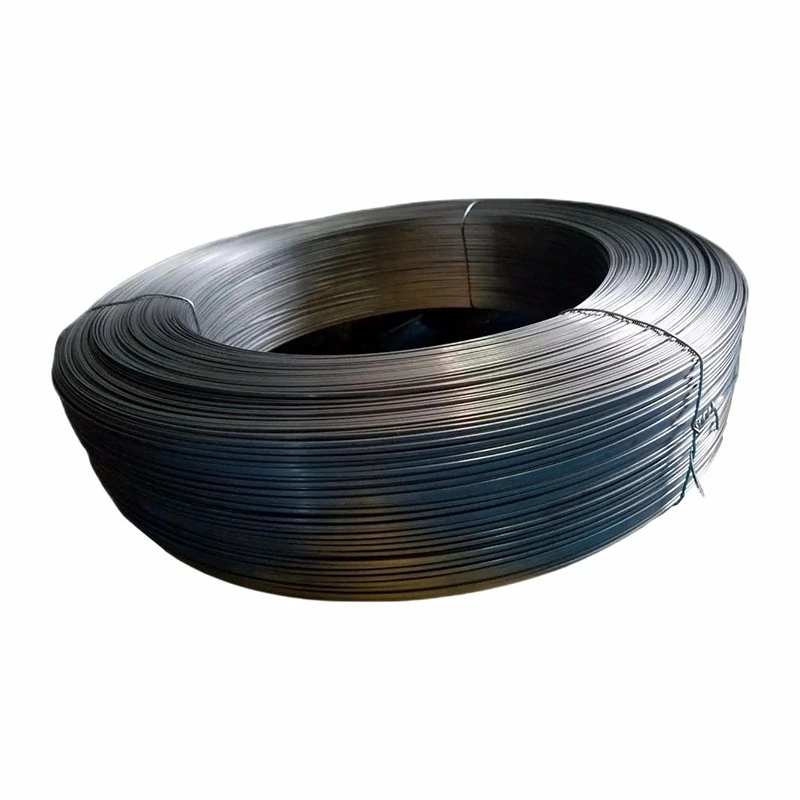
Contact Us for Procurement and洽谈
If you are interested in purchasing round steel wire or have any questions about our products, we encourage you to contact us. Our team of experts is always ready to assist you with your procurement needs and provide you with detailed technical information and support. We look forward to working with you and helping you find the best steel wire solutions for your applications.
References
- Callister, W. D., & Rethwisch, D. G. (2014). Materials Science and Engineering: An Introduction. Wiley.
- Ashby, M. F., & Jones, D. R. H. (2005). Engineering Materials 1: An Introduction to Properties, Applications, and Design. Butterworth-Heinemann.
- Budynas, R. G., & Nisbett, J. K. (2011). Shigley's Mechanical Engineering Design. McGraw-Hill.