

How does the diameter of steel wire affect its strength?
As a seasoned steel wire supplier, I've witnessed firsthand the pivotal role that wire diameter plays in determining the strength of steel wire. Over the years, I've engaged with countless clients, from small - scale manufacturers to large - scale construction companies, all seeking the perfect steel wire for their specific applications. In this blog, I'll delve into the intricate relationship between the diameter of steel wire and its strength, drawing on both industry knowledge and real - world experiences.
Understanding the Basics of Steel Wire Strength
Before we explore the impact of diameter, it's essential to understand what we mean by the strength of steel wire. Strength in steel wire can be measured in several ways, including tensile strength, yield strength, and fatigue strength. Tensile strength refers to the maximum amount of tensile (pulling) stress that a wire can withstand before breaking. Yield strength, on the other hand, is the stress at which a wire begins to deform permanently. Fatigue strength is the ability of the wire to withstand repeated loading and unloading cycles without failure.
The Influence of Diameter on Tensile Strength
One of the most straightforward relationships in the world of steel wire is the connection between diameter and tensile strength. Generally speaking, as the diameter of a steel wire increases, its tensile strength also tends to increase. This is because a larger - diameter wire has a greater cross - sectional area. When a load is applied, the stress (force per unit area) is distributed over a larger area in a thicker wire compared to a thinner one.
For example, consider two steel wires made from the same material. Wire A has a diameter of 1 mm, and Wire B has a diameter of 2 mm. The cross - sectional area of a wire is calculated using the formula (A=\pi r^{2}), where (r) is the radius of the wire. For Wire A with (r = 0.5) mm, the cross - sectional area (A_{A}=\pi(0.5)^{2}= 0.25\pi) (mm^{2}). For Wire B with (r = 1) mm, the cross - sectional area (A_{B}=\pi(1)^{2}=\pi) (mm^{2}), which is four times larger than that of Wire A.
When a pulling force is applied, the stress on Wire A will be four times higher than the stress on Wire B for the same applied force. As a result, Wire B can withstand a higher pulling force before reaching its breaking point, demonstrating higher tensile strength.
In industrial applications, this relationship is crucial. For heavy - duty lifting operations, such as in construction or mining, thick - diameter steel wires are often preferred. They can handle large loads without breaking, ensuring the safety and efficiency of the operations. For instance, in a construction site, steel cables with large diameters are used to lift heavy building materials like steel beams and pre - cast concrete elements.
Yield Strength and Diameter
Yield strength is another important aspect affected by wire diameter. Similar to tensile strength, a larger - diameter steel wire typically has a higher yield strength. When a load is applied to a wire, it initially deforms elastically, meaning it will return to its original shape once the load is removed. However, once the yield strength is exceeded, the wire begins to deform permanently.
A thicker wire is more resistant to this permanent deformation. The internal structure of a larger - diameter wire can better distribute the stress caused by an applied load, delaying the onset of plastic deformation. In applications where precise dimensions and shape retention are critical, such as in the manufacturing of springs, understanding the relationship between diameter and yield strength is essential.
For high - performance springs used in automotive suspensions, for example, the spring wire needs to have a high yield strength to ensure that it can withstand repeated compression and extension cycles without deforming permanently. Using a wire with an appropriate diameter helps to achieve the desired yield strength and performance.
Fatigue Strength and Diameter
Fatigue strength is perhaps the most complex aspect of wire strength when it comes to the influence of diameter. In some cases, a larger - diameter wire may have better fatigue strength. A thicker wire has more material to resist crack initiation and propagation under cyclic loading. Cracks are less likely to form and spread quickly in a wire with a larger cross - sectional area.
However, the relationship is not always straightforward. The manufacturing process of the wire, its surface finish, and the type of cyclic loading also play significant roles. For example, in some applications where the wire is subjected to high - frequency, low - amplitude cyclic loading, a thinner wire may perform better. Thinner wires can sometimes dissipate the energy of the cyclic load more effectively, reducing the likelihood of fatigue failure.
In the aerospace industry, where components are subjected to a wide range of cyclic loads, engineers carefully consider the diameter of steel wires used in various parts. For aircraft control cables, the diameter is chosen based on a balance between fatigue strength, weight, and flexibility requirements.
Other Factors Affecting the Relationship
While diameter is a significant factor in determining wire strength, it's not the only one. The material composition of the steel wire is crucial. Different grades of steel have different inherent strengths. For example, high - carbon steel generally has higher strength than low - carbon steel. Alloying elements such as chromium, nickel, and manganese can also enhance the strength properties of the wire.
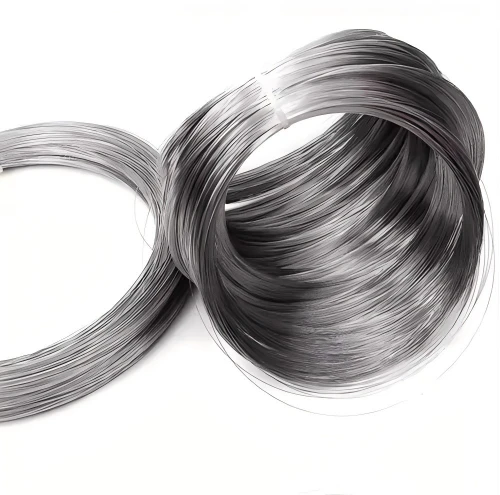

The manufacturing process also has a profound impact. Cold - drawn steel wires, like Cold Drawn Spring Wire Rods, often have higher strength compared to hot - rolled wires. Cold drawing involves pulling the wire through a die at room temperature, which aligns the grain structure of the steel and increases its strength.
Surface finish is another factor. A smooth surface finish can reduce stress concentrations, which are points where the stress is much higher than the average stress in the wire. Stress concentrations can lead to crack initiation and premature failure. For example, Steel Cut Wire Shot is used in some processes to improve the surface finish of steel wires, enhancing their overall strength and durability.
Applications and Diameter Selection
Different applications require different wire diameters based on their strength requirements. In the manufacturing of Flexible Duct Wire, a thinner wire is often used. These wires need to be flexible enough to form the duct structure while still providing sufficient strength to maintain the shape. A thinner wire allows for greater flexibility without sacrificing too much strength.
In contrast, in the production of steel ropes for marine applications, thick - diameter wires are used. These ropes need to withstand the harsh marine environment, including strong winds, waves, and the weight of heavy loads. The large diameter provides the necessary strength and durability to ensure the safety of ships and offshore structures.
Conclusion
In conclusion, the diameter of steel wire has a significant impact on its strength, including tensile strength, yield strength, and fatigue strength. A larger - diameter wire generally has higher tensile and yield strengths due to its greater cross - sectional area, which allows for better stress distribution. However, the relationship with fatigue strength is more complex and depends on various factors.
As a steel wire supplier, I understand the importance of helping our clients select the right wire diameter for their specific applications. Whether you're involved in construction, automotive manufacturing, aerospace, or any other industry that uses steel wire, we can provide you with the expertise and high - quality products you need.
If you're interested in learning more about our steel wire products or need assistance in choosing the right wire diameter for your project, I encourage you to reach out to us. We're here to work with you to ensure that you get the best - suited steel wire for your application, guaranteeing optimal performance and safety.
References
- "Mechanical Properties of Metals" by George E. Dieter
- "Materials Science and Engineering: An Introduction" by William D. Callister Jr. and David G. Rethwisch
- Industry reports on steel wire manufacturing and applications