

How to calculate the stress on carbon steel wire?
Hey there! As a carbon steel wire supplier, I often get asked about how to calculate the stress on carbon steel wire. It's a crucial topic, especially for those in industries like construction, manufacturing, and engineering. So, let's dive right in and break it down.
First off, what is stress? In simple terms, stress is the force applied to a material per unit area. When it comes to carbon steel wire, understanding stress helps us determine how much load the wire can handle before it fails. This is super important for ensuring the safety and reliability of any structure or product that uses our carbon steel wire.
There are two main types of stress we need to consider: tensile stress and shear stress. Tensile stress occurs when a wire is pulled apart, like when you're using a wire to lift a heavy object. Shear stress, on the other hand, happens when two parts of the wire slide past each other in opposite directions.
Let's start with calculating tensile stress. The formula for tensile stress (σ) is pretty straightforward:
σ = F / A
Where:
- σ (sigma) is the tensile stress in pascals (Pa) or pounds per square inch (psi).
- F is the force applied to the wire in newtons (N) or pounds (lb).
- A is the cross - sectional area of the wire in square meters (m²) or square inches (in²).
To find the cross - sectional area of a round carbon steel wire, we use the formula for the area of a circle:
A = π * (d/2)²
Where d is the diameter of the wire. For example, if we have a carbon steel wire with a diameter of 5 mm (or 0.005 m), the cross - sectional area would be:
A = π * (0.005/2)² = π * (0.0025)² ≈ 1.9635×10⁻⁵ m²
Now, let's say we're applying a force of 500 N to this wire. Using the tensile stress formula, we can calculate the stress:
σ = 500 N / 1.9635×10⁻⁵ m² ≈ 2.546×10⁷ Pa
That's a lot of stress! But whether this is too much or not depends on the properties of the specific carbon steel wire we're using.
Carbon steel wires come in different grades and qualities. For instance, our Cold Drawn High Carbon Steel Wire has different mechanical properties compared to Ungalvanized High Carbon Patented Steel Wire. High - carbon steel generally has a higher strength, which means it can withstand more stress before breaking.
When it comes to shear stress, the formula is a bit more complex, but still manageable. The average shear stress (τ) is given by:
τ = V / A
Where:
- τ (tau) is the shear stress in pascals (Pa) or pounds per square inch (psi).
- V is the shear force in newtons (N) or pounds (lb).
- A is the cross - sectional area of the wire in square meters (m²) or square inches (in²).
Shear stress often occurs in applications where the wire is subjected to forces that try to cut or slice through it. For example, in a wire rope used for towing, there may be shear forces acting on the individual wires within the rope.
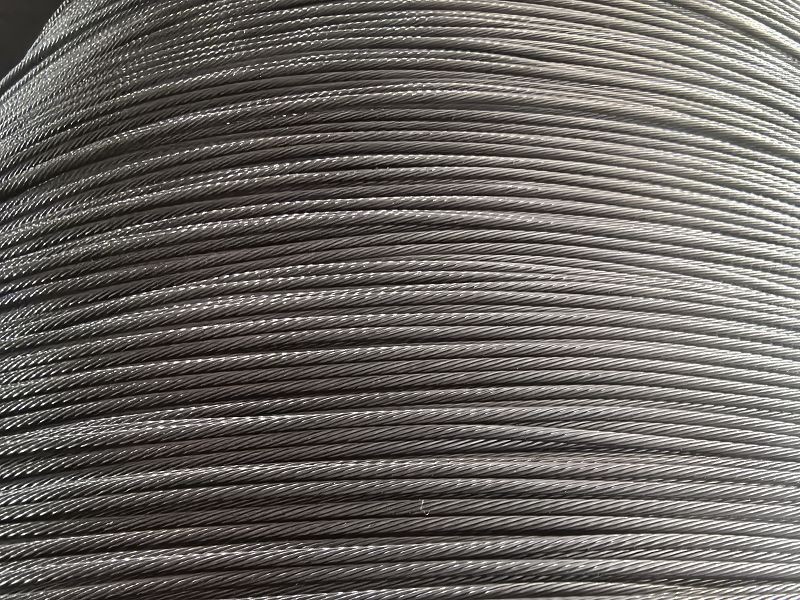
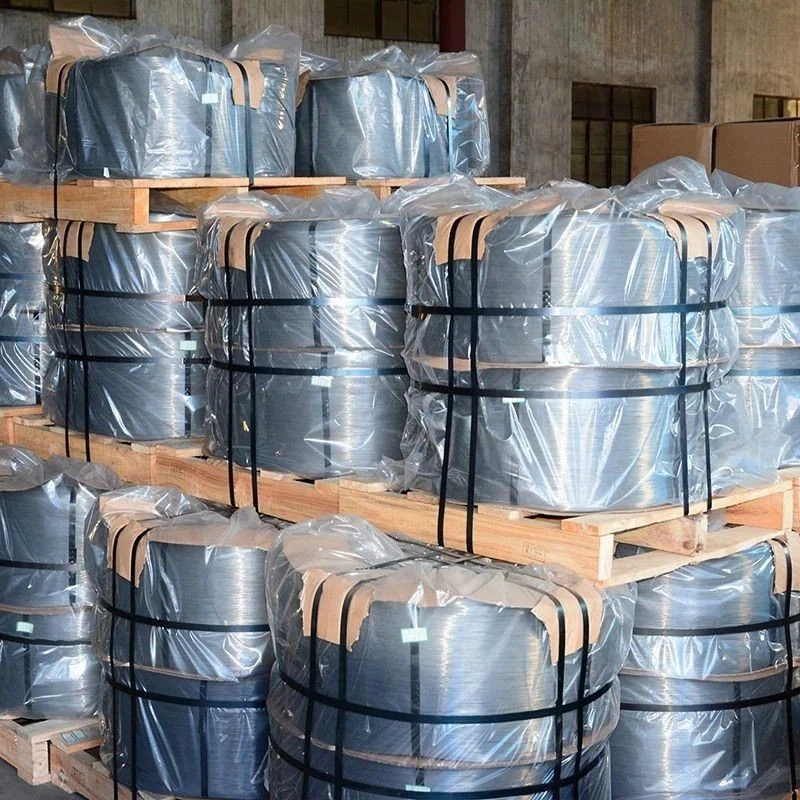
Another important factor to consider is the yield strength and ultimate strength of the carbon steel wire. The yield strength is the stress at which the wire starts to deform permanently. Once the stress exceeds the yield strength, the wire will not return to its original shape when the force is removed. The ultimate strength, on the other hand, is the maximum stress the wire can withstand before it breaks.
Let's take a look at an example of a High Carbon Steel Wire Rope. Suppose we're using it to lift a heavy load. We need to make sure that the stress on the individual wires within the rope does not exceed their yield strength during normal operation and their ultimate strength under extreme conditions.
To calculate the stress in a wire rope, we first need to know the total load being lifted and how the load is distributed among the individual wires. This can get a bit tricky because the load distribution depends on factors like the construction of the rope (e.g., the number of strands and wires per strand) and the way the rope is attached to the load.
In some cases, we may also need to consider the effect of bending stress. When a wire is bent, there is a combination of tensile and compressive stresses on the inner and outer surfaces of the bend. The stress due to bending can be calculated using the following formula:
σ_b = M * c / I
Where:
- σ_b is the bending stress in pascals (Pa) or pounds per square inch (psi).
- M is the bending moment in newton - meters (N·m) or pound - inches (lb·in).
- c is the distance from the neutral axis to the outer surface of the wire in meters (m) or inches (in).
- I is the moment of inertia of the cross - sectional area of the wire in meters to the fourth power (m⁴) or inches to the fourth power (in⁴).
Bending stress is important in applications where the wire is used in pulleys, sheaves, or other curved structures.
So, how do we use all this information in real - world situations? Well, as a carbon steel wire supplier, we work closely with our customers to understand their specific applications. We can provide them with the technical data for our wires, including the yield strength, ultimate strength, and other mechanical properties. This helps them calculate the stress and ensure that they're using the right wire for the job.
If you're in the market for high - quality carbon steel wire, whether it's Cold Drawn High Carbon Steel Wire, Ungalvanized High Carbon Patented Steel Wire, or High Carbon Steel Wire Rope, we're here to help. We can offer advice on stress calculations, recommend the best wire for your application, and provide samples for testing.
If you're interested in discussing your carbon steel wire needs further, don't hesitate to reach out. We're always happy to have a chat and work together to find the perfect solution for your project.
References:
- "Mechanics of Materials" by Ferdinand P. Beer, E. Russell Johnston Jr., John T. DeWolf, and David F. Mazurek.
- "Materials Science and Engineering: An Introduction" by William D. Callister Jr. and David G. Rethwisch.